

Pain Is Weakness Leaving the Body
Anyone who skateboards knows that single second of complete biological overload. You try a pop shove-it, the board flips around in midair, and the edge slams straight into your shinbone at full speed.
At first, nothing happens. Your nervous system simply refuses to clock in. Then comes that dry, wooden thud, followed by an ice-cold wave of pure pain that shoots straight into the pit of your stomach. You collapse in silence, curl your toes into your insoles, and wait for the nausea to hit. While you're crouched on the asphalt, blood rushes beneath the periosteum and forms a purple lump within thirty seconds that looks like a freshly stitched-in chicken egg. If your legs don't look like the bark of a rotting oak tree by the end of summer, you either cheated (shin guards are not an option, you're not an overpaid soccer player) or you spent all day rolling a fingerboard across your desk.
The skateboard shouldn’t take the blame in this situation. The problem is rather evolutionary sloppiness. Millions of years were wasted armoring vital organs with thick rib cages, yet on the front of your lower legs, bare bone sits directly under a layer of paper-thin skin. Thanks, natural selection.
So that you don't fold like a wet sack every time wood meets bone, the Bonkers Research & Development Department has created a training program designed to permanently eliminate your pain receptors.
Phase 1: The Early Bird Gets the Bedframe
The program starts first thing in the morning. Everyone has broken their pinky toe on a bedpost in the dark at least once. We're using that exact mechanism, just moving the point of impact four inches higher.
Every morning right after getting up, kick the edge of your bedframe dead-on three times at full force, before you've even had your first coffee or remembered who you are. The harder the bedpost, the better; we recommend oak. The goal of this exercise is to bluntly batter those fine nerve endings until they surrender and stop sending signals upstairs to central command. If a cold sweat doesn't immediately break out across your pores, you went in too soft. Harder!
Phase 2: The Rolling Pin
Inspired by Far Eastern monastery myths in which monks supposedly fell trees with their shins, we raid the kitchen drawer. You’re looking for a heavy rolling pin. Beechwood works well here.
Sit on the floor, stretch your legs out, and roll the pin across your shins using your full body weight. As soon as you hit small bumps, old scar tissue, or fresh hematomas, stop right on that spot and rock back and forth in short pulses. The sound resembles dry crispbread being crushed under a car tire. That is no cause for concern. It is merely the sound of yielding tissue. If it feels like someone is scraping your periosteum off with a wire brush, your technique is clean.
Phase 3: The Shopping Cart
Find the biggest Aldi parking lot in your neighborhood. Grab an empty wire-mesh shopping cart, get it up to a full sprint, and let it crash straight into your legs without braking.
The advantage over a skateboard is obvious: the cart hits both shins simultaneously and completely symmetrically. That saves valuable training time. If passersby watch you and ask whether you've lost your mind, don't answer. Just stare back at them with a completely blank expression while you pull the metal contraption back for the next run.

Phase 4: Streetlights
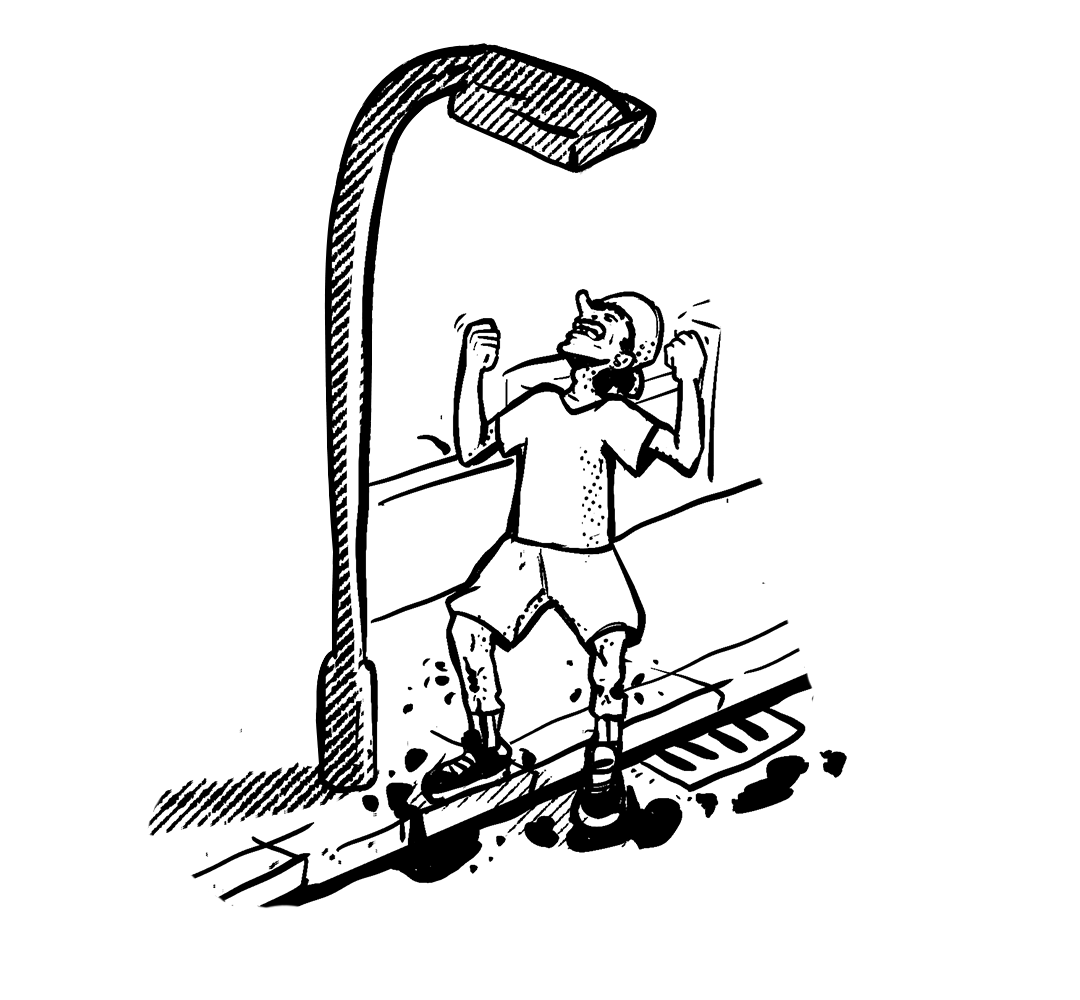
There is also a night training session that delivers maximum results with minimal equipment: the classic streetlights-kicking routine, only this time with your shin. Pick a street of your choice, ideally on the outskirts or out somewhere in a backwater town. Set a timer for five minutes and shut down the entire block via shin-to-pole contact. If you fail to kick out every streetlight within the allotted time, wait briefly until the street lights back up and start over from the beginning. Repeat this until the whole road is pitch black and the local residents think the power grid just collapsed.
Phase 5: Biological Optimization
After a few weeks of consistent training, you will notice the bone losing mass while deep dents remain. A sports physician would frantically babble about chronic periostitis, tissue necrosis, or irreparable trauma. Nonsense! We file this under targeted weight reduction. Less bone mass means less weight on your feet, which mathematically makes your pop shove-its higher. You have successfully adapted your anatomy to your equipment. When you run a finger down your shin and it feels like a dead tree branch with zero sensation left, you have reached your training goal.
Conclusion
Get out there, botch your next flip trick, and laugh in your deck's face when it strikes again. Since there aren't too many sessions happening during winter anyway, now is the perfect time to start training so you can roll into spring fully optimized. Your primary care doctor might stare in disbelief at your next checkup and ask which medieval dungeon you escaped from, but that's the price of true immunity to pain.

Illustrations by Sebastian Fuchs
Read more
Are skate shops really turning into nothing more than time machines for dudes who have to pop an Ibu 600 before dropping in and wonder if their health insurance is gonna cover a meniscus tear? Betw...
We all know the drill. Your bank account barely covers a pack of rolling filters. Your shoes are eighty percent saliva and bottom-shelf hot glue from Home Depot because Shoe Goo is simply too expen...