

No Future, Again?
Youth culture has always sucked at standing still. Action triggers reaction. Bourgeois pettiness gives rise to a counteraction, and the second that counteraction becomes the new normal, the next generation is already lined up to tear the whole circus down again.
The hippies wanted peace, sexual liberation, and a different society. Make Love, Not War. Behind all of that, despite a backdrop of real war, was an astonishingly optimistic premise: the world is broken, but we can build a better one. A few years later, England’s youth screamed "No Future" across the Channel. That was not some abstract dread of the atomic bomb, it was a reckoning with a society in decay: piles of trash choking London streets, strikes waves, factory closures, and an unmistakable message to working class youth that there simply was no seat at the table for them. Punk asked: If all we’re going to do is standing in the unemployment line anyway, why play nice and live like our parents? Punk was filthy, loud, and above all, nihilistic. Where hippies still wanted to save the world, a discarded generation of Punks did not even have faith in the next three months. The establishment reacted with disgust and police batons. This provided the ultimate fuel: a real opponent.
Recent years, by contrast, have been mind-numbingly sterile. Beige apartment, beige outfit, beige mindset. Quiet luxury, Pilates, run club, morning routine, recovery score. Even free time got slapped with KPIs. Count steps, track sleep, shave down the pace, optimize output. In theory, there is nothing wrong with that. Working out is great, health matters, and eight hours of sleep is probably smarter than a three day bender. But in the end, this collective aesthetic amounted to a single, heavily sedated promise: Fifty Shades of Beige.
Everyone’s perfectly curated, athletic, clean, and identically boring. Heaven forbid anyone does something different. The obsession with optimization is not the mark of a rebellious youth; it belongs to a generation that already packed its rebellion away before it even had a chance to start. A generation that settled into corporate life and surrendered to pseudo-moral guidelines. People whose most transgressive act is doing lines of coke in a back room. That’s when rebellion is replaced by running a marathon: you cannot control the world, but you very much can control your pace.
Adolescence, on the other hand, is half-baked. Young folks fall head over heels for the wrong people, listen to god-awful music, fuck up, get hurt, and wear clothes that will make them cringe ten years later. They’re are searching for something they can anchor themselves, their feelings, and their thoughts to. They want to be different, but they do not want to be alone. Identification and belonging are the core reasons subcultures even exist in the first place. Music, clothes, slang, and physical spots give them room to experiment while signaling to the rest of the world who they are.
During the pandemic, most of this search for belonging was banished behind a screen. Life went digital overnight, with social media serving as the only tether to the outside world. A few years later, we can see what a bizarre reality this created. Influencers hawk authenticity as a business model. Brand engineers fake communities just to give their products a veneer of street cred. Culture gets diluted to the point where a soulless brand reel passes for genuine identity. We started warping reality to fit social media. Then we acted all surprised when social media stopped feeling real.
Now, young people are starting to handle social media differently. They are still consuming relentlessly, sure, but consuming is not the same as participating. That’s because young people rarely post anymore. Social media promised to bring people together, and for a while, it did. Today, it’s an algorithm-based polarizing machine that still delivers dopamine-hits, sure, but that doesn’t inspire creativity any longer. Also, people don’t feel the need to document every single moment anymore. Private accounts, tight group chats, word of mouth, and meeting up in real life are getting more important again. It is the obvious backlash against total visibility. When anyone can see everything, the stuff hidden from view is suddenly the only thing that matters. Call it dialectic.
At the same time, cultural self-education has never been this frictionless. A smalltown teenager can discover Rotterdam gabber music in an afternoon, jump straight into Japanese punk, spend two hours bingeing vintage skate videos right after, and end the night hooked on hip-hop. Before our age of instant availability, that kind of multi-genre discovery took years. You had to have older friends, access to bootleg zines, or sheer dumb luck. Now, all it takes is Wi-Fi. The internet threw open every cultural archive of the last 70 years to anyone with a connection. That’s fantastic. But it does not mean everyone lines up neatly in their respective scenes anymore, on the contrary. Nobody has to be strictly punk, raver, goth, hip-hop head, or metalhead. Subcultures that once occupied hostile opposite corners of the schoolyard now coexist naturally in the exact same playlist.
The catch is that the veterans, the ones who have lived through these scenes, need to shut the fuck up every once in a while. "That is not real techno." "That is not how punk looked back then." "Everything used to be better." Congratulations, you turned into your parents. Knowing the history matters. But subculture does not belong to the people who got there first. The older crowd needs to set the stage, but the new generation deserves the space to make their own mess on it.
The real problem: the minute a subculture takes root, the monetization machine is already gearing up. The industry has always strip-mined underground culture; what has changed is the velocity. It used to take a decade for an idea to travel from a sweaty basement to a department store rack. Today, a look goes viral, and within weeks, a soulless, mass-market knockoff hits the shelves. The need to belong becomes a target demographic, a secret code turns into an aesthetic, and what once meant "this is us" gets reduced to "shop the look." A subculture that includes everyone ceases to be a subculture; it is just mainstream pop culture.
That’s why gatekeeping is making a comeback, even though social media was supposed to kill it off. And it is not just about guarding against corporate exploitation. Not everything needs to scale. After years in the hyper-visible churn, we are learning that value does not lie in visibility, but in obscurity. In a world where everything is ripped off and monetized in seconds, choosing not to be seen is genuinely liberating.
For that to work, though, you need physical sanctuaries. Young people need places where they can just hang out without constantly being treated as customers, students, or told to keep it down. Instead, rents are skyrocketing, rehearsal spaces are vanishing, youth centers are starved of funding, and public places are privatized for commercial use. Subculture rarely thrives where someone drafted a pitch deck first. Subculture needs the dive bar, the club with the dirty restrooms, and the public plaza you are technically not allowed to skate in.
Skate shops are textbook examples. They were never just retail storefronts pushing decks and shoes. They were makeshift town squares, grassroots information hubs, and youth clubs free of social workers proselytizing about the dangers of drugs. You stepped into a skate shop to kill time, and you immersed yourself in the music and the videos. You were put on a direct collision course with subcultures whether you wanted to be or not. You showed up for the skating and stayed for the heads.
When places like these disappear, sure, you can still order shit online. But as physical spaces vanish, the culture slowly fades with them. And once the culture is cold in the ground, interest in the product itself is bound to follow. An online store simply can't replace an afternoon spent loitering in a skate shop, getting in the staff's way, running into friends, and picking up on details that end up inspiring you. Protecting these spaces isn't pure nostalgia; it keeps the next generation from becoming totally apathetic, which is the foundational prerequisite for any future interest in the product. Skate shops are what make it compelling in the first place, and that’s what actually drives future sales. Digital storefronts simply can't provide the room for that kind of connection. The internet can point you to the door, but it is not the room behind it.
On top of that, every generation requires friction, usually aimed at the generation right before it. But what happens when the previous generation's rebellion becomes the establishment? Which brings us right back to the industry. For years, brands have had a good time not offending anyone. They want culture as a scenic backdrop, but they cannot stomach the rough edges that come with it, let alone bankroll the conditions that birthed it. They want the flawless skater, but not the skate rats making noise on the street. They want the underground club as an edgy wallpaper for a campaign, but they don’t want the noise complaints. Everyone wants to harvest the commercialized fruits of culture, but nobody wants to fertilize the soil. If brands keep bleeding subcultures dry without protecting the spaces that foster them, in five years they will not have anything left to copy-and-paste onto their mood boards.

Integrity is what you do when the cameras are not rolling. That applies to brands just as much as it does to local shops. If you try to appeal to everyone, you end up meaning nothing to anyone.
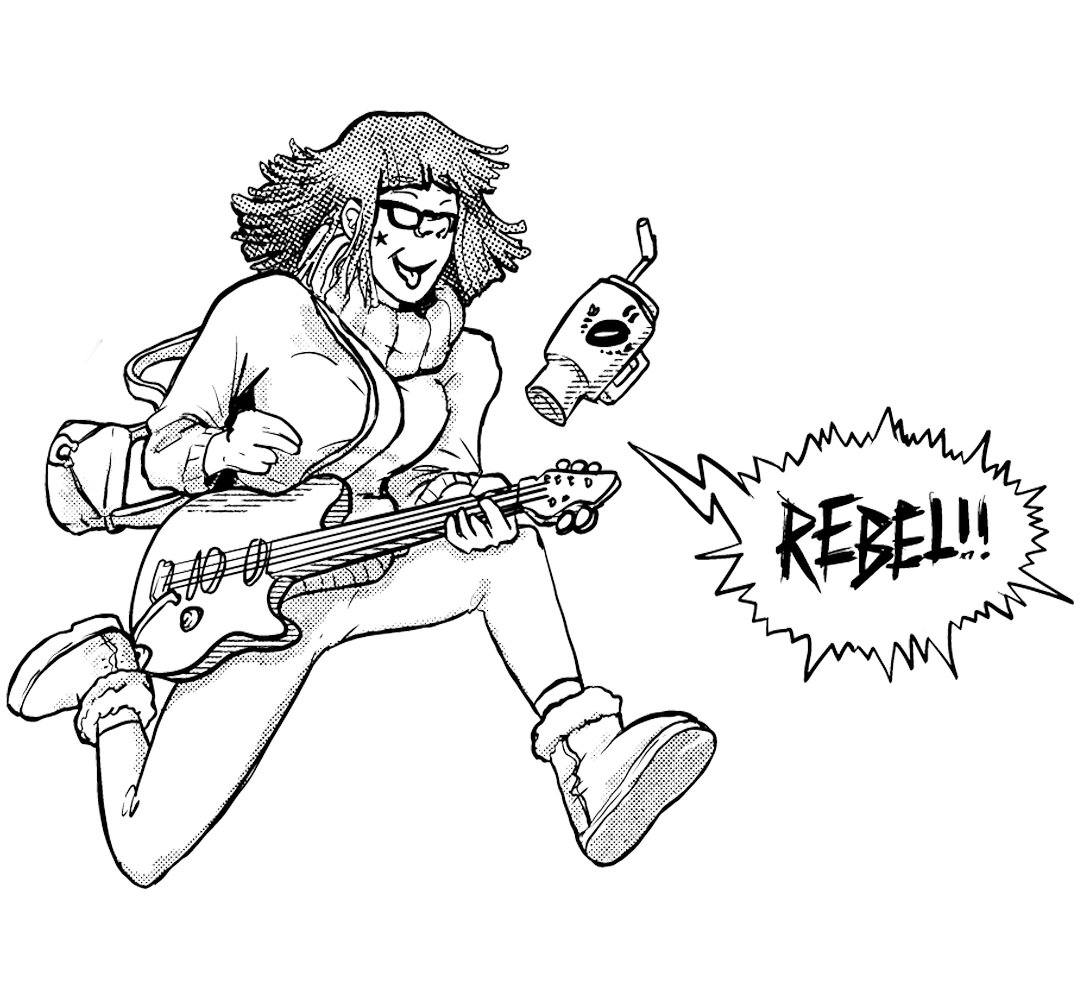
So why bother rebelling at all if the future feels empty? Rebellion does not need the grand illusion of saving the world. Sometimes, all it takes is a simple statement: we don’t know what we’re doing, but we sure as hell are not doing it your way. A subculture does not have to fix society. It carves out a pocket universe within the larger one, governed by its own rules. Staying off the radar, keeping things tactile, doing something gloriously pointless that drives other people crazy. Not because the past was some golden era, but because every generation deserves the goddamn right to figure out who they are.
No future? Possibly. But at least it won’t be yours!
Text by Martin Schreiber
Illustrations by Sebastian Fuchs
